
Clinic management / Engineering case study
Homeopathic Management API
Role-aware Django API for clinic operations.
Project facts
Authenticated APIs
Privacy-aware boundaries
Clinical workflow support
Administrative service integration
Overview
A public architecture overview of a clinic-management API. Patient data, medical decision rules, billing calculations, inventory formulas, and workflow transitions are intentionally omitted.
01 / Context
The problem
A clinic platform coordinates scheduling, clinical records, inventory, and billing while protecting patient context and keeping each responsibility within the correct access boundary.
My role
I contributed authenticated APIs, permission boundaries, clinical workflow support, inventory integration, and billing foundations. No patient data, medical decision rule, or pricing formula is included in this case study.
Constraints
Patient context and clinical responsibilities required careful privacy boundaries. Medical rules, billing calculations, inventory formulas, and workflow states could not be disclosed.
02 / Engineering
Technical decisions
Django REST Framework provides a documented API with server-side role enforcement and validated changes. Clinical and operational areas remain connected through explicit application boundaries rather than exposing sensitive records broadly.
Medical logic, billing calculations, inventory formulas, record schemas, and workflow transitions are intentionally omitted.
Validation
Validation focused on documented API behavior, representative role boundaries, and the public contract between connected service areas.
03 / Delivery
What the project delivers
The repository demonstrates an integrated clinic-management API with clear authentication and domain boundaries while keeping medical, billing, and operational rules private. It makes no healthcare-outcome claim.
Lessons and next steps
In sensitive domains, authorization and data minimization must shape the API contract from the beginning. Adding them after workflows are built creates avoidable exposure risk.
Architecture overview
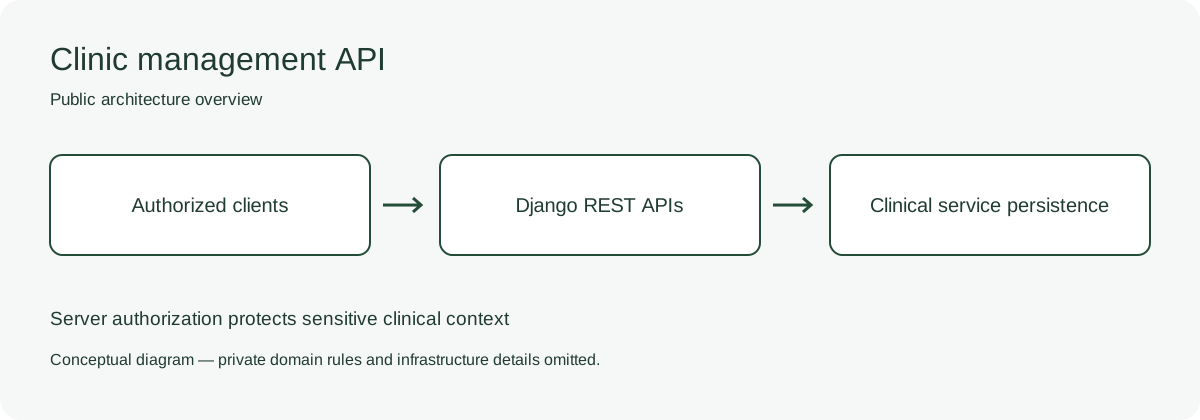
A documented Django REST API separates authenticated access, clinical responsibilities, and administrative services. Medical rules and record structures remain private.
This public summary omits private domain rules, data relationships, security policies, and operational details.
Engineering challenges
Protecting sensitive context
Context: Clinical and administrative capabilities have different privacy needs.
Decision: Use role-aware backend boundaries without publishing medical or policy rules.
Trade-off: Role-aware boundaries increase permission complexity but reduce unnecessary data exposure.
Validation: Validation focused on representative permitted and rejected access.
Keeping connected areas cohesive
Context: Several clinic responsibilities must cooperate without becoming one tightly coupled module.
Decision: Keep service responsibilities explicit and expose a consistent public API.
Trade-off: Separate responsibilities improve maintainability while requiring explicit contracts between services.
Validation: Validation focused on the documented contract between public API areas.
Technical focus
Django REST Framework
Authenticated API access
Sensitive-domain boundaries
Documented API contracts
Public architecture diagram
Interested in work like this?
This public case study demonstrates engineering judgment without exposing internal business logic.
Let’s start a conversation ↗