
Hotel operations / Engineering case study
HotelMotel
Django API foundation for hotel operations.
Project facts
Backend APIs
Modular domain organization
Access boundaries
Automated behavior checks
Overview
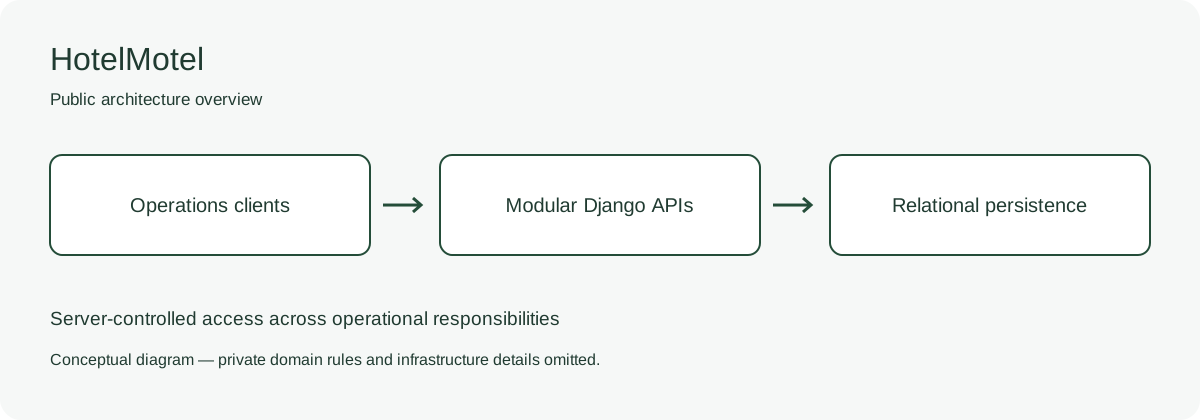
A public architecture overview of a modular hotel-operations backend. Pricing, availability, staff procedures, state transitions, and model relationships are intentionally omitted.
01 / Context
The problem
Hotel operations combine planned reservations with real-world activity, shared inventory, financial information, and staff responsibilities. The backend needed clear domain boundaries and consistent state changes.
My role
I contributed backend APIs, domain organization, lifecycle handling, access controls, and automated tests across the hotel operations foundation. Pricing, availability formulas, and staff procedures are not published.
Constraints
Connected operational responsibilities needed consistent behavior while pricing, availability, staff procedures, and state rules remained private.
02 / Engineering
Technical decisions
The Django backend separates operational concerns into maintainable modules and validates access and consistency at server-controlled boundaries.
This case study does not disclose state-machine rules, pricing calculations, inventory algorithms, staff procedures, or internal model relationships.
Validation
Validation focused on public API behavior, representative permission outcomes, and interactions between maintainable modules.
03 / Delivery
What the project delivers
The work established a testable API foundation for hotel operations with clearer ownership and authorization boundaries. It makes no claim about production occupancy, revenue, or customer usage.
Lessons and next steps
Operational systems become easier to change when responsibilities have clear ownership and shared behavior is validated at module boundaries.
Architecture overview
A modular Django API separates major operational responsibilities while shared application services coordinate cross-domain work. Sensitive procedures remain private.
This public summary omits private domain rules, data relationships, security policies, and operational details.
Engineering challenges
Keeping operational concerns maintainable
Context: Connected hotel operations can become tightly coupled.
Decision: Separate responsibilities into focused modules with clear ownership.
Trade-off: Modular ownership improves clarity but requires explicit coordination between responsibilities.
Validation: Validation focused on the public behavior of connected modules.
Controlling sensitive actions
Context: Authenticated access alone is not sufficient for every operation.
Decision: Apply server-side authorization while keeping staff procedures private.
Trade-off: Narrow authorization is safer than broad access but expands the permission scenarios that need validation.
Validation: Validation focused on representative permitted and rejected actions.
Technical focus
Django REST API
Modular domain boundaries
Server-side authorization
Automated behavior checks
Public architecture diagram
Interested in work like this?
This public case study demonstrates engineering judgment without exposing internal business logic.
Let’s start a conversation ↗