
Real estate marketplace / Engineering case study
TheProperty
Role-aware Django property marketplace.
Project facts
Django foundation
Private workspaces
Service boundaries
Production configuration
Overview
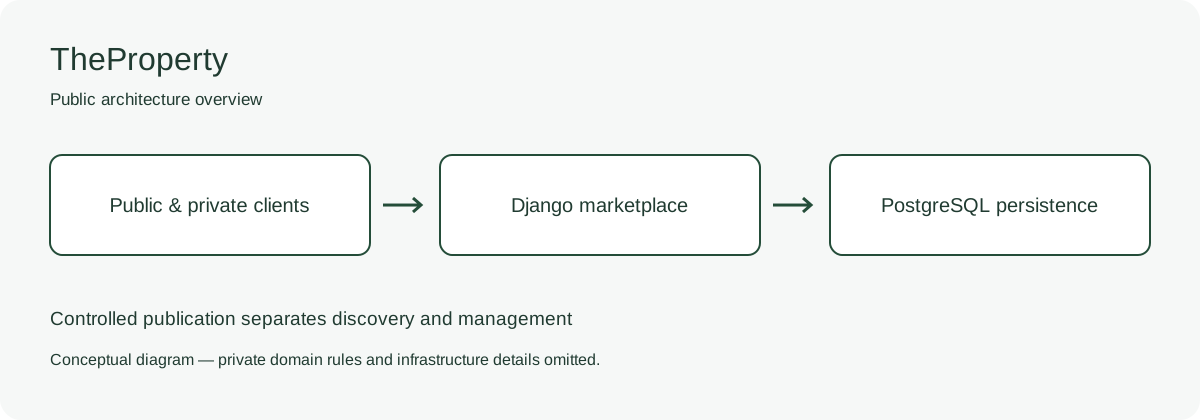
A public architecture overview of a property marketplace with controlled publication and protected private capabilities. Review criteria, ranking behavior, document details, and commercial rules are intentionally omitted.
01 / Context
The problem
A property marketplace must support public discovery while keeping unpublished inventory, private account material, and staff-only decisions outside the public surface.
My role
I contributed the Django marketplace foundation, role-oriented workspaces, service boundaries, production configuration, and automated safeguards. Internal moderation and commercial responsibilities are intentionally summarized rather than reproduced.
Constraints
Public discovery and private management required different visibility boundaries. Review criteria, document details, ranking behavior, and commercial rules could not be published.
02 / Engineering
Technical decisions
Public discovery and private management capabilities are separated through server-side authorization and explicit publishing controls. Sensitive files use protected delivery, and important administrative changes remain traceable. Business operations are kept behind service boundaries instead of being spread across views and templates.
Review criteria, marketplace state rules, ranking behavior, identity-document details, and commercial workflows are not disclosed.
Validation
Validation focused on representative public and authenticated paths, publication visibility, and protected private capabilities.
03 / Delivery
What the project delivers
The project demonstrates a production-oriented marketplace foundation with controlled publication, protected private material, and auditable administration. No transaction volume or commercial outcome is claimed.
Lessons and next steps
Moderated marketplaces need publication state, authorization, and auditability to reinforce one another. Hiding controls in the interface is never a substitute for backend enforcement.
Architecture overview
A server-rendered Django application separates public discovery, private workspaces, and administrative responsibilities. Review criteria and commercial rules remain private.
This public summary omits private domain rules, data relationships, security policies, and operational details.
Engineering challenges
Separating discovery from management
Context: Public browsing and private management have different visibility needs.
Decision: Keep public and private capabilities behind distinct application boundaries.
Trade-off: Distinct boundaries improve privacy but require careful coordination of shared presentation needs.
Validation: Validation focused on representative public and authenticated paths.
Keeping publishing controlled
Context: Content should appear publicly only after the appropriate internal decision.
Decision: Use explicit publishing controls without disclosing review criteria or state rules.
Trade-off: Controlled publishing adds workflow overhead while preventing accidental public visibility.
Validation: Validation focused on public visibility before and after publication.
Technical focus
Django and PostgreSQL
Controlled publication
Protected private capabilities
Auditable administration
Public architecture diagram
Interested in work like this?
This public case study demonstrates engineering judgment without exposing internal business logic.
Let’s start a conversation ↗